Washington State Department of Transportation
―Ballast Island

Creative Director: Nicole Fischetti
Designer: Daniel Neifert, Jessica Cooper, Peyton Todd
Project Manager: Samantha Segar
Historian: Jennifer Ott, HistoryLink
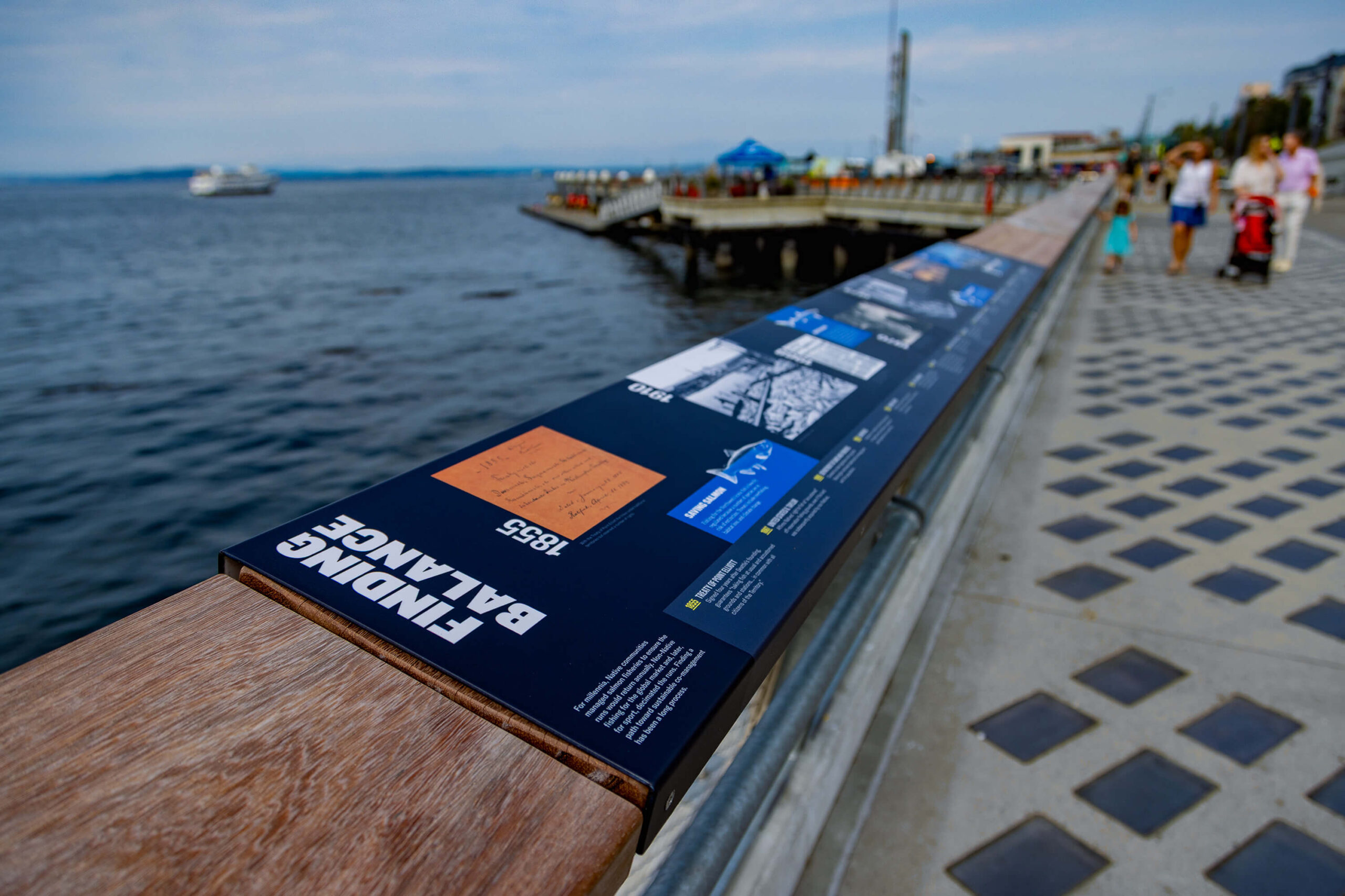
One of the most important and troubling stories we were asked to help tell along Seattle’s regenerated waterfront is the history of Ballast Island. Designed as part of the new Colman Dock ferry terminal, this permanent installation stands within view of where the island once stood.
Long before Ballast Island existed, Coast Salish communities lived and thrived along Elliott Bay. In the 1850s, Native people made space for incoming settlers, who increasingly occupied areas where tribal villages had long been established. Industrial fill, piers, and rail trestles overtook the shoreline, displacing Coast Salish people from much of their traditional land.
Ships arriving in Seattle to load coal and lumber discarded ballast, the heavy material used to stabilize empty cargo ships. Over time, the piles of stone grew into an artificial island and eventually connected to the shoreline. As part of this project, we were entrusted with historic ballast stones to tell the story — these are some of the very rocks that formed Ballast Island in the 1800s. Much of the ballast is believed to have come from San Francisco’s Telegraph Hill, including the sandstone on display.
By the late 1800s, Native people were almost entirely pushed out of the city. Ballast Island had become the last place along the waterfront where Native people could come ashore. Families camped there while conducting business and trade. Despite hostility and exclusion, Ballast Island remained an important Indigenous foothold into the 1890s. The site continues to hold deep significance today.
The installation shares this difficult history through extensive research and Indigenous perspectives. Developed as part of the Alaskan Way Viaduct Replacement Program and the redevelopment of Colman Dock, the project was created in consultation with the Muckleshoot, Suquamish, Tulalip, Snoqualmie, and Stillaguamish Tribes, as well as the Duwamish Tribal Organization.
“No matter how much impervious surface is created, no matter how big of a skyscraper is built, it doesn’t erase … any of the culture, any of the history, any of our ties.”
— Warren King George, Muckleshoot, 2017